
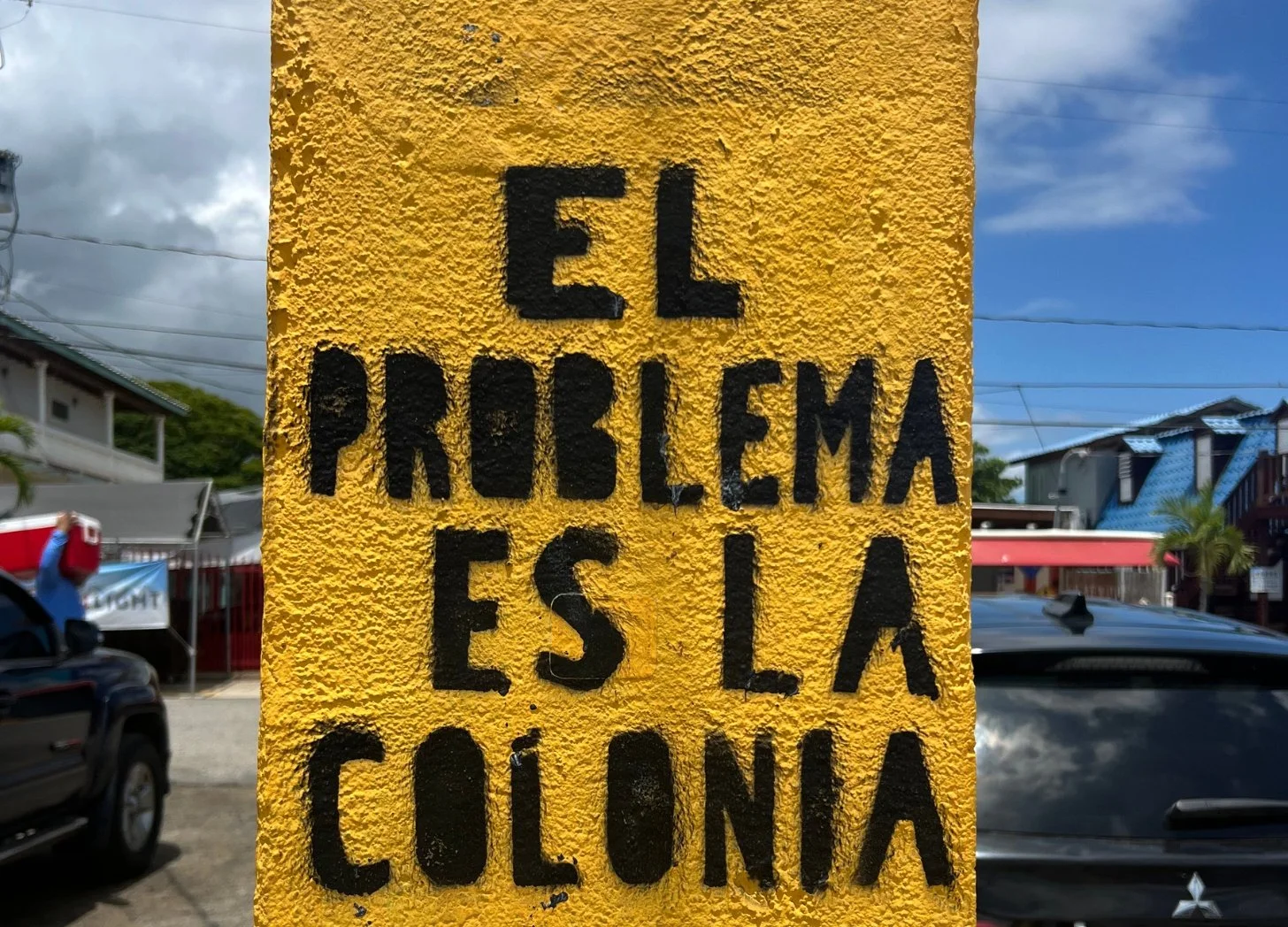
Taken on a trip to Puerto Rico. The sign reads: ‘El problema es la colonia’ — ‘The problem is the colony.’
I just returned from a trip to Puerto Rico. There to celebrate my grandpa’s 91st birthday and continue the quiet, meaningful pursuit of the recipes that will one day shape my cookbook.
As I made my usual rounds, from my grandmother’s house to my aunt’s, my cousins’, and even old friends, I found myself moving across the island with a feeling I couldn’t quite name. Something was different. As I pondered, I realized what it was…The weight of time. Not just my own, but that of a people. A culture. A place.
Puerto Rico, to me, is home. I wasn’t born there, but it’s everything I’ve ever known culturally. It gave me my parents, my family, my childhood, and a kind of warmth I’ve never felt anywhere else. It's the smell of pan sobao (sweet bread) from the local panadería (bakery), the way elders say “bendición” as a blessing, the sound of old salsa classics floating out of someone’s window mid-afternoon. But what I saw this time, or rather, what I finally came to recognize, was vastly different.
A hard truth, I wish I could unsee (or better yet, wish wasn’t true at all).
The fondas, where people used to gather for a hot plate of arroz con habichuelas (rice and beans), have slowly been replaced by Burger King drive-thrus. The panaderías that served café con leche (coffee) and quesitos (cheeses) are becoming chain coffee shops. More English than Spanish on signs. Just as many American flags as Puerto Rican ones. I asked both friends and family about this and was met with a sort of indifference that shook me. A quiet, unsettling sense that we’ve already given up. And most striking of all, a numb kind of acceptance, as if this shift was always inevitable.
But it wasn’t.
And it isn’t.
This isn’t a blame piece. It’s not a call-out. It’s a reflection on the slow, almost invisible erasure of culture, my culture, and how, sometimes, we don’t notice it’s happening because we’ve been taught to embrace the very systems that dilute it.
I don’t say this lightly, but in many ways, Puerto Rico is being Americanized into silence. The colonial status isn’t just political, it’s psychological. We’ve been taught to assimilate and to mold our identity into something that feels more “palatable.” That kind of messaging, absorbed over generations, makes people believe that this shift is normal. That this version of Puerto Rico, more franchises, fewer fondas, is progress.
But at what cost?
In my search to better understand this shift, here are some facts:
Puerto Rico has been a U.S. territory since 1898. Never a state, yet never fully sovereign. It’s a space suspended between autonomy and assimilation.
The Jones Act (1917) granted U.S. citizenship, but not full rights or representation. An arrangement that still shapes everything from disaster response to trade. [Source]
In 2023, the island's average age reached nearly 45 years old, one of the oldest populations in Latin America and the Caribbean. [Source]
More Puerto Ricans now live in the mainland U.S. than on the island itself. [Source]
A staggering number of younger generations are choosing not to have children, due to economic instability, climate concerns, or perhaps simply not seeing a future here. [Source]
Meanwhile, gentrification and tax incentives (like Act 60) are pushing locals out of their homes, while foreign investors buy up land and profit from a culture they may not understand. [Source]
When I say my people are dying, I don’t just mean literally, though that is happening, too. I mean, we’re being displaced. Disconnected. We’re losing the essence of who we are while still dancing to the same rhythms and speaking the same language. But the infrastructure, the spirit, the soul of what makes Puerto Rico, Puerto Rico, it’s under threat.
When I look at my grandparents, I realize they may be the last generation that remembers Puerto Rico before this kind of shift. They carry the recipes, the idioms, the sense of collective care. And I wonder: what happens when they’re gone? What happens when no one remembers the stories? What happens when the coquito is store-bought, the music is pre-programmed, and the place we return to is no longer ours?
This is not a declaration of defeat…It’s a plea for awareness.
I don’t think culture disappears overnight. It dissolves slowly, quietly, when we stop naming it. When we stop preserving it. When we forget that we are its carriers. It slips through our fingers in the everyday moments we no longer protect, in the language we let fade, in the recipes we stop passing down.
I write this not from a place of bitterness, but from love. A deep, generational love. I love Puerto Rico. I love our food, our language, our traditions. I love the sound of my grandmother’s voice when she says “ven acá.” I love the warmth of a meal made with sofrito from scratch. Not just for the flavor, but for what it represents: time, intention, inheritance. I love the spirit that refuses to die, even as the systems try to extinguish it. The resilience that pulses beneath every hardship, every act of erasure.
But I know that love isn’t enough. We have to name what’s happening. We have to care enough to notice. We have to be brave enough to say: This matters. Still. Even when it feels like no one’s listening. Even when we’re told to move on, modernize, assimilate.
Because if we don’t, we may wake up one day to find that Puerto Rico, the one we remember, the one we hold in our hearts, no longer exists. The smells, the sounds, the soul of it all… gone.
And worst of all, we won’t even know when it disappeared. Because it didn’t vanish in a single moment, it was lost in pieces, not out of malice, but by becoming passersby to our own culture, rather than participants in its preservation.