
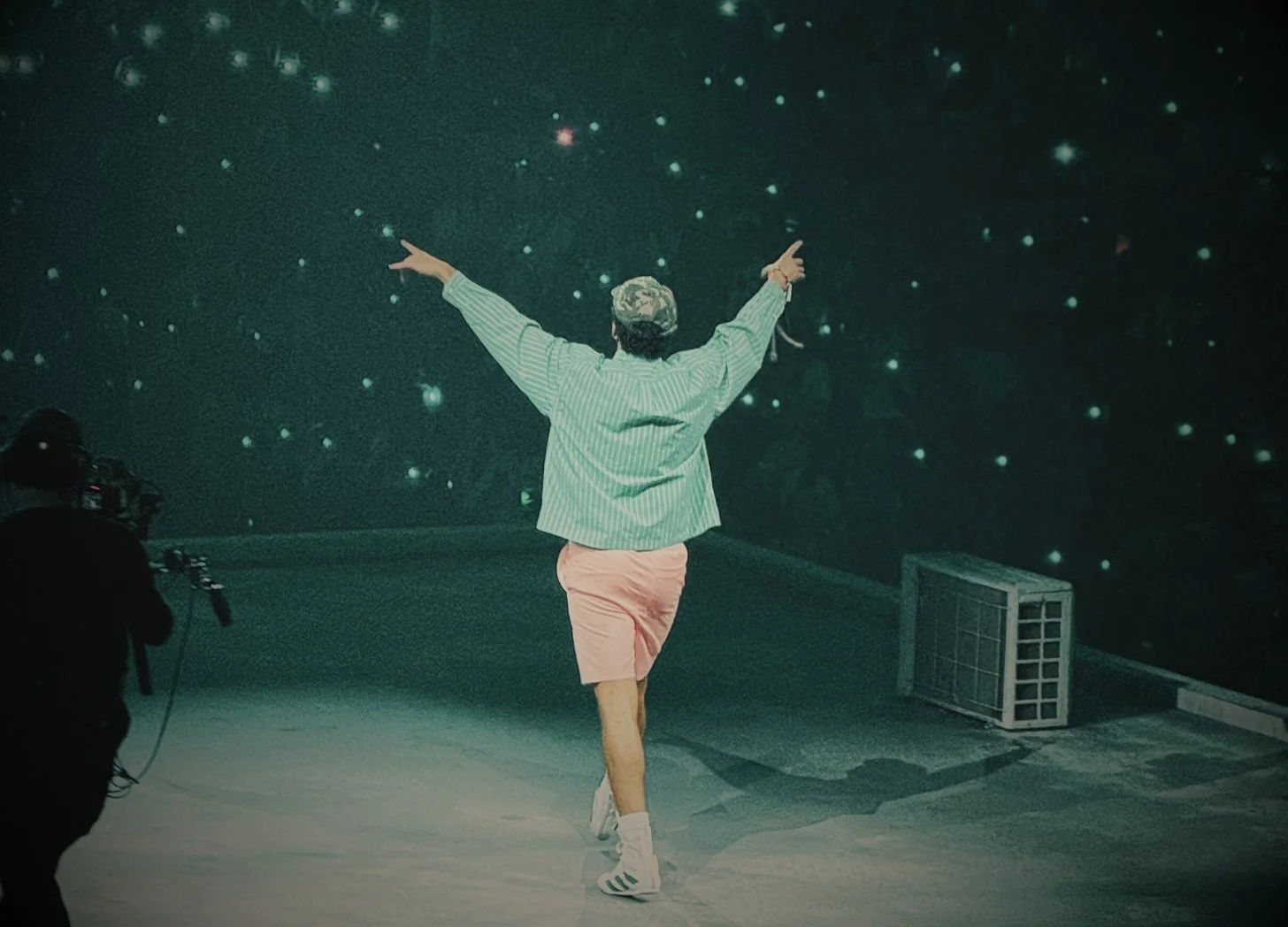
As most of us, at least we Americans, know, the Super Bowl took place last Sunday, when Bad Bunny performed at the halftime show.
And afterwards…
I intentionally didn’t post anything. Not that night. Not the day after. And really not until today.
I remained quiet because I’ve learned that sometimes silence is louder than reaction. I live by intentionality, and that matters more than being first. Or being the loudest. I believe that when something lands this deeply, especially for me, I do not rush it.
In context, I’ve lived in a country that has spent my entire life teaching me how to be smaller, so I’ve learned to take my time and show up as prepared as possible.
So, I did just that. I sat with it. I gathered. Processing what I watched unfold. What people said. What it revealed. And of course, I thought about what I wanted to say, and then I let it settle before I opened my computer to write down my thoughts.
This piece is not written for those who immediately understood the significance of the performance or embraced it without hesitation. It is written for those who experienced it differently. For those who expressed either confusion, discomfort, anger, or all three. It’s for the people who felt excluded by 13 minutes and 42 seconds of Spanish-language music on the biggest stage in America.
And before I say anything. This isn’t to shame. The truth is complicated and very uncomfortable on both sides. But it does reveal where we are as a country more than a halftime show ever could.
I woke up on Monday morning, truthfully elated. I had hosted a party with all my friends, they had the best time, and nothing fills my cup more than cooking and showing up for those around me.
But as the commentary rolled in, I started feeling depleted. Helpless.
One person in particular stated that it was “a middle finger to the rest of America.” The person argued that while we may have 40 million Spanish speakers in the United States, we have 310 million who don’t speak “a lick of Spanish.”
It begs the question of whether that ratio alone should determine whose American culture gets centered on national stages.
To provide some perspective, according to the U.S. Census Bureau, approximately 43.4 million Americans speak Spanish as their primary language at home. A figure that importantly excludes those who speak or understand Spanish but do not use it as their primary language.
People like me. Who are bilingual but speak English at home.
Or the roughly 20% of all K–12 students enrolled in a language course of some kind. Many of those are Spanish classes. Or those who can understand it at a functional level, but perhaps can’t speak it. Another tidbit that shouldn’t be excluded if we are understanding the comment as not “Spanish speakers” but essential people who don’t understand “a lick of Spanish.” So, when institutions like Instituto Cervantes and Pew Research Center model these figures out, they estimate that 1 in 5 Americans understands Spanish.
And I get it, that’s still not half of the population or the majority, but it’s more than the “40 million Spanish speakers.”
I saw another person say, “Nobody understands a word this guy is saying.” But based on the figures above, then “nobody” is not only a gross exaggeration but factually incorrect. And yes, I’m aware, this person stated “nobody” to provide emphasis, so let me emphasize this: I believe the more articulate and more truthful thing to say would have been, “I don’t understand what he’s saying, and I’ve mistaken my experience for someone else’s.”
As I continued down the rabbit hole, I saw that an organization described the Super Bowl as something that “should stay quintessentially American.” My educated guess is that this implies either Spanish-language music isn’t American or that Bad Bunny isn’t American or both.
So, here are some facts. Bad Bunny is American. Puerto Ricans are United States citizens. This isn’t symbolic. It’s constitutional. Puerto Rico has been a U.S. territory since 1898. People born there are born American. They hold U.S. passports. They have historically ranked alongside the top states in terms of military service per capita. So, to add a bit of my own color, if we are good enough to fight American wars, then I imagine we are most definitely considered “quintessentially American.”
This ultimately makes clear that Bad Bunny is not a foreign artist who was given a platform on American soil. He is an American artist performing in his own country.
Should the argument instead be about language, not whether people understood it, as I addressed earlier, but whether English is the official language of the United States, and therefore singing in Spanish isn’t American, then you should note that while on March 1, 2025, President Trump signed Executive Order 14224, titled “Designating English as the Official Language of the United States, this is not the same as federal law. In order to make English the official language of the U.S. nationwide in statute, Congress would have to pass a law, and the president would have to sign it. As I write this article, that has yet to happen. So, given that English isn’t the official language, singing in Spanish or, for that matter, in any other language, would be a “quintessential American” representation. Unless, of course, the comment was made based on cultural judgment rather than fact.
Lastly, I saw another person say that the performance was “absolutely terrible, one of the worst, EVER!” Further stating that it is “an affront to the Greatness of America” and “doesn’t represent our standards of Success, Creativity, or Excellence.”
And while this is, in fairness, simply an opinion, one I welcome, as we should all be able to have one, I would offer some facts that help explain why billions of others around the world strongly disagree.
Bad Bunny was Spotify’s most-streamed artist globally for three consecutive years—2020, 2021, 2022, and he reclaimed that spot again in 2025 with 19.8 billion streams. The only artist to hold the global No. 1 spot four times. He is the first American artist performing primarily in a non-English language to dominate global streaming at that scale. He has done this in countries that are not Spanish-speaking, Canada, Germany, the Netherlands, and by some of these individuals’ standards, even the “non-Spanish-speaking” United States.
So I ask, when someone says they don’t represent American standards of success or excellence, by what measure and by whose standard?
And while on that note, if I may offer my own perspective beyond the facts I’ve provided, I explored a theory that I believe helps explain why feelings of confusion, discomfort, and anger may exist in response to this cultural moment.
There is a body of research in sociology and social psychology known as Group Threat Theory, first introduced by sociologist Herbert Blumer in 1958 and later expanded by Hubert Blalock Jr. and contemporary scholars such as Diana C. Mutz. The core idea is that when a historically dominant group perceives its status, cultural centrality, or demographic majority to be declining, it can trigger psychological threat responses, even when its actual material power remains intact.
This is not about actual marginalization. It’s about perceived symbolic displacement.
So long as a majority exists in the U.S., and English remains dominant across its institutions, moments of non-English prominence in national symbolic spaces like the Super Bowl halftime show can feel unusual, and unfamiliarity alone can trigger discomfort.
But we must be clear that unusual is not the same as oppression. And discomfort is not the same as exclusion.
For those of you who felt these emotions while watching Bad Bunny’s performance is what millions of other Americans feel every single day.
You might have felt it for 13 minutes and 42 seconds, but others feel it constantly. Daily. Incessantly.
So, I urge you to sit with these questions:
Why does a Puerto Rican performing in Spanish feel like a violation of “quintessentially American” culture, but an English-speaking performer does not?
Why is Bad Bunny, the most-streamed artist globally, dominating charts in non-Spanish-speaking countries, breaking every conceivable measure of cultural influence, not considered “successful” or “excellent” enough to represent American standards?
Why does representation for Hispanic Americans feel like erasure of everyone else, but representation that excludes them feels neutral?
What I can offer is that if you can feel discomfort, then I’m hopeful that you can also feel empathy. And for what it’s worth, it wasn’t about excluding you. It was about finally including us.
As for me, I am an American. I was born in New York to parents who left Puerto Rico for a life they believed would give their children more opportunities. I grew up speaking Spanish at home and English everywhere else. I learned early on that to succeed in the U.S., you code-switch. You adapt. You make yourself palatable. And unfortunately, I spent a lot of my life doing just that.
It’s what I learned to do as a minority. You learn to exist in spaces that weren’t built for you, and you don’t complain about it because what is perceived as complaining makes those in power, regardless of the room, uncomfortable. At least, that has been my experience.
So when Bad Bunny walked onto that stage and performed entirely in Spanish, unapologetically, confidently, as if he belonged there because he does, the little girl in me felt seen.
I realized how deeply and for how long I had internalized the idea that my culture was meant to be private. That Spanish was something you spoke at home, not something you performed on a national stage.
And in those 13 minutes, Bad Bunny shattered that idea completely. The cultural center shifted. Not away from America. Toward a fuller, more accurate version of it.
He didn’t apologize for who he is or what part of America he was born in. He didn’t translate. He just showed up as himself and forced America to reckon with the fact that this is what America looks like, too.
And that’s the thing about cultural anxiety: it always precedes normalization.
Irish Catholics were once seen as foreign. Italian Americans were once considered “not fully American.” Jazz was controversial. Hip-hop was controversial.
And yet, all of those cultural forms eventually became woven into the fabric of what we consider American.
This is not a threat. This is the continuation of a pattern that has defined American culture from the beginning.
So, the question is not whether Hispanic culture will influence America. It already has. The question is whether you interpret that influence as expansion or erosion.
I don’t expect this to change everyone’s mind. I know some people will read this and still believe the halftime show was inappropriate. That it should have been in English and that it violated some unspoken rule about what belongs on a national stage.
But I genuinely and deeply hope that at least some of you will sit with the discomfort a little longer. That you’ll ask yourself why you felt excluded when millions of people finally felt included.
Bad Bunny didn’t take anything away from America by performing in Spanish. Asking him to perform differently would have meant asking an American artist to diminish his own expression in his own country. It also would have asked America to be less itself. Instead, he reminded us that the tent is bigger than some of us thought. And there’s room for all of us inside it.